
Saint Hilary of Poitiers
Feast Day: January 13
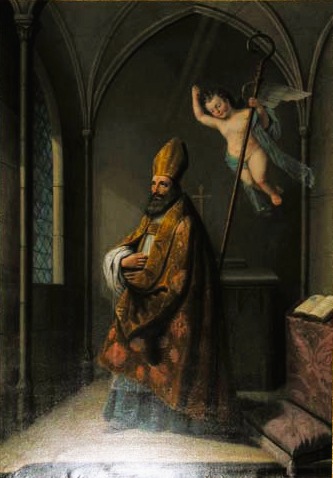
Saint Hilary was a native of Poitiers in Aquitaine. Born and educated a pagan, it was not until near middle age that he embraced Christianity, moved to that step primarily by the idea of God presented to him in the Holy Scriptures. He soon converted his wife and daughter, and separated himself rigidly from all non-Catholic company, fearing the influence of error, rampant in a number of false philosophies and heresies, for himself and his family.
He entered Holy Orders with the consent of his very virtuous wife, and separated from his family as was required of the clergy. He later wrote a very famous letter to his dearly-loved daughter, encouraging her to adopt a consecrated life. She followed this counsel and died, still young, a holy death.
In 353 Saint Hilary was chosen bishop of his native city. Arianism, under the protection of the Emperor Constantius, was then at the heights of its exaltation, and Saint Hilary found himself called upon to support the orthodox cause in several Gallic councils, in which Arian bishops formed an overwhelming majority. He was in consequence accused to the emperor, who banished him to Phrygia. He spent his more than three years of exile in composing his great works on the Trinity.
In 359 he attended the Council of Seleucia, in which Arians, semi-Arians, and Catholics contended for the mastery. He never ceased his combat against the errors of the enemies of the Divinity of Christ. With the deputies of the council he went to Constantinople, and there so dismayed the heads of the Arian party that they prevailed upon the emperor to let him return to Gaul. He traversed Gaul, Italy and Illyria, preaching wherever he went, disconcerting the heretics and procuring the triumph of orthodoxy. He wrote a famous treatise on the Synods. After some eight years of missionary travel he returned to Poitiers, where he died in peace in 368.
Reflection. Like Saint Hilary, nearly every Christian has always lived amid unbelievers and heretics. We are called to a lifelong contest, and shall succeed in the measure we combine abhorrence of error with compassion for its victims.
Patronage
Children with Disabilities – Mothers – Sick People – Lawyers
Source: sanctoral.com
Birthplace
Born
AD 310
Pictavium, Roman Empire
(Poitiers, France)
Death
AD 367
Pictavium, Roman Empire
(Poitiers, France)
Canonized
Pre-Congregation
Shrine/Relics/Tomb
Poitiers, France
Learn more:
FaithND – University of Notre Dame
Exploring the Saints – St. Hilary of Poitiers – Faith.ND.edu
St. Hilary was hailed by the best minds of his age as an “illustrious” teacher and a “most eloquent man”—high praise from St. Augustine and St. Jerome, two of the greatest theologians the Church has ever known…
Word On Fire
Our Debt of Gratitude to St. Hilary of Poitiers – WordOnFire.org
Jan 13, 2026 — I doubt if many of us have a devotion to St. Hilary of Poitiers, whose feast day we celebrate today. Yet, our being Christian is indebted to him. Here’s why. Hilary was born in France at the beginning of the fourth century and was elected bishop of Poitiers in AD 350. His time as bishop was marked by controversy…