
Transcript – Homily of Fr. Michael O’Conner, Our Lady of the Gulf Catholic Church, Bay St. Louis, MS. (June 24, 2026)
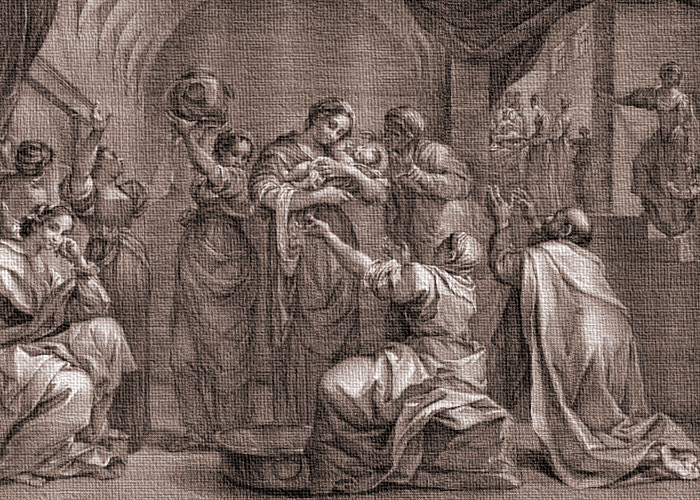
We celebrate John the Baptist a couple of times. And once we celebrate his martyrdom—when we read about Salome and the dance and all that, and him getting his head chopped off—but today, we read about his birth, and we read the Old Testament prophet Isaiah.
This idea that John the Baptist was in God’s mind and John the Baptist’s life had a plan and that God in his providence had set these things in motion. What about you? Does God know you? Does God have a plan for you? You better say yes. That may not be the same as John the Baptist, right? We’re not going to write a gospel story about you. Okay, but at the same time, there is this universality to the predestination that we have a destiny to fulfill. And John fulfilled his destiny courageously and beautifully, and so John’s one of my heroes. I hope he’s one of your heroes. We all have to have a hero or two or three or five or ten.
When we read the Bible, as we read this morning, and we read the prophet Isaiah, and we read the Acts of the Apostles, and then Zechariah and all that, there’s so much there right on the surface, but I’m going to let St. Augustine take us under the surface for a minute this morning. I’m going to read a little reflection from St. Augustine from the office of readings. So, I didn’t come up with this. This is St. Augustine.
The Church deserves the birth of John as in some ways sacred. You will not find any other of the great men of old whose birth we celebrate officially. That’s the point right there. Jesus and John, we celebrate their birth. We celebrate John’s as we celebrate Christ’s.
This point cannot be passed over in silence. And if perhaps I cannot explain it in a way such an important matter deserves, it is still worth thinking about a little more deeply and fruitfully than usual.
John is born of an old woman who is barren. Christ is born of a young woman who is a virgin. That John will be born is not believed and the father is struck dumb that Christ will be born is believed, and he is conceived by faith.
I have proposed some matters for inquiry, and listed in advance some things that need to be discussed. I have introduced these points even if we are not up to examining all the twists and turns of such a great mystery, either for lack of capacity or for lack of time. You will be taught much better by the one who speaks in you—that’s the Holy Spirit. When I am not here, the one about whom you think loving thoughts, the one whom you have taken into your heart, whose temple you have become.
So, pause from my reading. St. Augustine is saying we need to let the Holy Spirit speak to us about these things that are between the lines of sacred scripture. So he goes on to say, John, it seems has been inserted into a inserted as a kind of boundary between the two testaments, the old and the new that he has somehow or other a boundary is something that the Lord himself indicates when he says the law and the prophets up into John. So, he had the law and the prophets. It’s the Old Testament. And then John comes ushering in the new.
He represents the old and heralds the new because he represents the old. He is born of an elderly couple because he represents the new. He’s revealed as a prophet in his mother’s womb. You will remember that before he was born at Mary’s arrival, he leapt in his mother’s womb already. He had been marked out there, designated before he was born. It was already shown whose forerunner he would be even before he saw him. These are divine matters and exceed the measure of human frailty.
Finally, he is born. He receives a name and his father’s tongue is loosed. Zechariah is struck dumb and loses his voice until John, the Lord’s forerunner, is born and releases his voice for him.
What does Zechariah’s silence mean? But that the prophecy was obscure and before the proclamation of Christ somehow concealed and shut up. And so, Zechariah is a symbol of the incompleteness of the old that can’t speak fully the full truth. It is released and opened up by Jesus’s arrival.
It becomes clear when the one who was being prophesied is about to come. The releasing of Zechariah’s tongue at the birth of John has the same significance as the tearing of the veil of the temple at the crucifixion of Christ. If John were meant to proclaim himself, he would not be opening Zechariah’s mouth. The tongue is released because a voice is born. For when John was already heralding the Lord, he who asked, who are you? He replied, I am the voice of one crying in the wilderness. John is the voice, but the Lord in the beginning was the word. John is the voice for a time, but Christ is the eternal word from the beginning.
Today, we remember John’s life, John’s birth, John’s courage, the plan that God had for John, and that God has a plan for us. That we have to be courageous and we have to strive to live the destiny that God has called us to.
On the Solemnity of the Birth of John the Baptist – Saint Augustine of Hippo